Showing posts with label star trek. Show all posts

February 27, 2015

for Leonard, or The Most Human


It's my brother's fault.

Since he's a baby boomer, his formative years were in the wake of Kennedy's New Frontier, when being an astronaut was considered the pinnacle of individual human achievement.  So, within that context, a television show about The Final Frontier couldn't help but be his favorite.

Needless to say, since I didn't come around until 4 years after the original "Star Trek" had been cancelled, we pretty much watched whatever my brother wanted to watch.

Which, frankly, was fine, because that show is still, probably, my favorite of all time.  I'm sure can practically recite entire episodes by heart.

Therefore, it should come as no surprise that, when I was 9 years old, the whole family, cousins and all, went to the theater to see "Star Trek II: The Wrath of Khan".

As I've said before on this blog, I cried my eyes out at the end of that movie, when Spock died.


 I mean, we went home, and had dinner, and I was still crying, to the point where my father had to take me from the table, sit my down on the living room couch, put an arm around me, and say "I'm sure Mr. Spock is going to be alright."

Which, was, of course, true, all the way up until today.

Now, as I mention in my book, The Savior Inside You , I absolutely wanted to be Captain Kirk.  I mean, who wouldn't, right?  He was the hero.  He was in charge.  Everybody looked up to him.  He was smart and cool and brave.  He got all the girls.

But everybody knows that Captain Kirk needs his best buddies, Dr. McCoy and Mr. Spock.  Now, most people have someone in their lives who can provide the folksy, down-home, irascible wisdom that DeForest Kelly spun each week as the ship's chief surgeon.  But no one had ever met anyone quite like Mr. Spock.

 Mr. Spock was the true soul of "Star Trek".  If the mantra of the show was to seek out new life and new civilizations, we, as the viewers, could literally do that every week just by tuning in and spending time with Spock.

The weird thing about TV characters is that, you see them week after week, you inhabit their fictional lives, you are compelled to care about them, to the point that some of us lose the ability to distinguish between the character and the actors that portray them.

So, beyond "Star Trek" reruns, I also spent a good chunk of my early 70's TV watching with Leonard Nimoy being my guide to the mysteries of the world through the old TV series "In Search Of."
In short, Leonard Nimoy, a man I'd never met, came to feel like a true family friend.

That is the beautifully weird alchemy that happens when you mix writing with performance to create a character that moves you like the living, breathing people in your life.

Oddly enough, on this day, when the world mourns Leonard Nimoy's passing, I find myself  filled with more wistful gratitude than sadness.   I am so very grateful how Mr. Nimoy's skill as an actor helped open my mind and heart to so much over the years.  In a very weird way, I'm grateful for his virtual companionship, as I suspect are so many others.

Thank you, Leonard.

#LLAP


January 04, 2013

Daily Nerdgasm - 01-04-13

April 20, 2009

No. 1 on the call sheet


This interview with J.J. Abrams about his process for the new "Star Trek", coupled with a Fast Company article about McG, where he likened directing a big budget movie to being hired as the CEO of a $200 million company that only gets to launch one product, put a new idea in my head.

So, I'm about a month away from starting serious casting for my feature film, and it occurred to me, for as many actors who want to be stars, how many of them are conscious of the responsibilities, from a filmmaking perspective, that stardom brings?

I'm reminded of a conversation Tom Cruise and Jada Pinkett Smith had with Tavis Smiley
just before the release of "Collateral", where Tom said, at the time, "I've never lost the studio money". It struck me at the time because, honestly, it hadn't occurred to me that he, as the star, felt personally responsible for making sure that the people who invested their money in his performance would see a return on their investment.

As a director, I'm reminding myself that it's not just important to cast someone who can give a performance, but someone who can also be a responsible filmmaker: supporting the performances for the other actors, treating onset crew with proper respect, being engaged in the evolution of their character with the director and the writer, using their fan base to promote the film, and, in many, many cases, helping to bring in the money to make sure there even IS a film to make in the first place.

It sounds like J.J. was very blessed by Chris Pine's onset presence. He was the star of the film, and he knew it, and acted appropriately.

I hope other actors are taking note - if you want to be a star, act like one. And that doesn't mean being a diva. It means being someone that a filmmaker and a producer and a studio and your castmates can put their trust and faith in. Being a star is about having broad shoulders.

Anyway, just something on my mind right now.

October 16, 2008

Mirror, Mirror

As I've mentioned in the past, one of my favorite episodes of the original Star Trek is entitled "The Enemy Within" - a transporter malfunction creates two versions of Captain Kirk.

One is intelligent, wise, compassionate, yet indecisive.

The other is....

Well, see for yourself:


Forceful? Yes. Decisive? Yes. But also crazed, lustful, paranoid.

And yet, as Spock points out, while separated, neither one is capable of surviving without the other. In the end, as much as the two repulse each other, they're forced to literally embrace each other to both survive and lead.

So, I've been following the coverage of the growing lynch mob qualities of the Palin/McCain rallies over the last few weeks.

And let's be real about this: McCain may be the official party nominee, but Sarah Palin is really the standard bearer for this particular facet of the Republican party these days. Given the choice, I'm sure many of them would prefer to have her at the top of the ticket simply because they trust her more. In their mind, she's one of them, through and through. McCain is, sadly, just someone who's hitched his carriage to them on the vain hope that this pony will carry him all the way to the Oval Office.

Honestly, I feel sort of sorry for both of them.

McCain, because, after the abuse he suffered at the hands of Bush & Co. back in 2000, could not get over his Presidential fixation and has debased himself over and over again by cowtowing to Bush, Falwell, et. al., hoping that these people that he once scorned will finally let him in the club. Frankly, much of his career has been spent seeking acceptance from the "cool kids". Originally, he hoped that by being a rebel Republican, he'd be popular among the Hollywood & press elites. And it worked. But it wasn't enough to get him elected, because as far as most Democrats are concerned, he's still a Republican. One they might want to have a beer with, but a Republican, nonetheless. So he did a switch, seeking favor from within his party. But, by then, it was too late, he'd pissed too many of them off. And the only reason he's the nominee now is because everyone else in the GOP field proved to be unacceptable to at least one sizable faction within the party (Rudy's too liberal and Romney's too Mormon for the cultural conservatives, and Huckabee was too much of a policy lightweight for the neocons and finance conservatives). In short, everyone else's constituencies killed the one guy they were the most offended by, and none of them were paying attention to McCain, leaving him the last man standing.

Sarah Palin's just like McCain in that her ambition consistently overrides whatever better judgment she may have about her career. I get the sense that when she was approached about taking the VP spot, she must have said to herself "well, how hard can it be?" My sympathy for her comes from the fact that she'll probably go down in the annuls of presidential election history in the same breath as Admiral Stockdale or Dan Quayle as a figure of national ridicule. But don't be misled. Even if McCain loses, we've probably not heard the last of Gov. Palin on the national stage.

Of course, there are limits to my sympathy.

And I suspect that McCain didn't fully appreciate the Frankenstein's monster he'd created by turning Palin loose to stoke up her base with the notion that Obama might somehow be a member of some fictitious joint Black/Muslim sleeper cell.


And, for the record, I'd just like to say two things:

1. If I were Obama, I would stand up during that prime time speech he's going to give the week before the election and say "Yes, my full name is, in fact Barack HUSSEIN Obama, and I have about as much in common with with Saddam Hussein as Bill Clinton has with George Clinton. Think, people!"

2. "Muslim" != "Enemy". My family was all raised in Protestant, Methodist traditions in the country churches on the Eastern Shore of Maryland. Yet, my uncle converted to Islam some 30 years ago. And I can tell you that he, his wife, and his six children are among the most thoughtful, considerate, compassionate, disciplined, spiritual people I have ever known. His Islamic faith has given him a core of inner peace and personal strength the likes of which I feel I have almost never seen among even Christian clergy. And the VAST majority of Muslims are like that. Blaming all Muslims for the actions of a man like Bin Laden is like blaming all Christians for the actions of Hitler. Or Jim Jones. Or Timothy McVeigh.

But my point is this:

Even if Obama wins in a landslide next month (which, according to FiveThirtyEight.com, has a better than 50% probability of occurring. Hope springs eternal), these people who are currently literally screaming for his head aren't going anywhere.

The fearful, the paranoid, the hateful - these, too, are very much part of America. Always have been.

And yet, in these very same parts of the country, you probably get the highest recruitment ranks from the military. The highest church participation and activism. These people love this country. Many of them have wildly different, and, in some cases, mutually exclusive view of what this country is supposed to be.

And, as long as no one is picking up a pitchfork or a rope, that's actually OK.

It's called democracy.

I know Kos likes to talk about "breaking their spirits" and Karl Rove was renowned for seeking a permanent Republican majority, the fact of the matter is, short of straight up genocide, neither side can ever get rid of the other.

No matter how much it disgusts or repulses us, that other America is still America. And we could not have what we have without it.

That's not to say that it's a good thing. Far from it. The provincial hatreds and prejudices and fears are, in my mind, a part of our national shame.

And the generational times are changing for the better. But I don't think any of us on either side of the divide should delude ourselves into thinking that we can ever be rid of the other completely.

So, with that in mind, we have to look for the common ground, where it can be found.

And, where it cannot, and it comes to a point where we have to lay hands on each other in a non-Christian way to resolve our differences...

Well, just the thought of that makes me sad. But I have to acknowledge that there may just be some people who are beyond reasoning.

At which point, like Jill Scott said, we just have to take off these rings and deal with it.

It's ALL America. The good and the bad.

But, personally, just like J.J. Abrams, I'm encouraged by the fact that Star Trek is making it's return in the same year that a transformative, hopeful figure like Barack Obama potentially becomes the new leader of the free world. It's no accident that Star Trek's Final Frontier was the projected future from JFK's New Frontier. I mean, who can dispute the Kennedy-eque qualities of a character like this:


Yes, it's always been a challenge. But I, for one, am filled with hope.

The hope that this country will have leadership again who will once again make us proud through their actions at home and abroad. The hope that we will find the means and the will to resolve our most pressing problems while capitalizing on our most golden opportunities.

I believe the cultural zeitgeist is changing. I believe the sci-fi worlds of "Blade Runner" and "Mad Max" where an outgrown of our sense that The Future was dying. But now, people have hope again. The future looks bright again.


There will always be serpents. But that doesn't make the fruits of the garden any less sweet.

December 21, 2007

What Happened To The Future?

So, I'm going to do something a little different with this particular post. This time, I'm actively seeking your opinions.

But first, of course, comes MY opinion. :-)

I think this particular train of thought started for me after watching the special features on the anniversary DVD for Ridley Scott's Alien. In an interview with the original screenwriter, Dan O'Bannon, he mentioned that he drew from a number of influences for inspiration for that story. In particular, a wild '60's Italian sci-fi film called "Planet of The Vampires" by Mario Bava, and "Strange Relations" a collection of short stories about the, shall we say, complications created by human/extraterrestrial sexual intercourse by sci-fi novelist Philip Jose Farmer.

At one point, O'Bannon was also involved in Alejandro Jodorowsky's attempt in the mid 70's to adapt Frank Herbert's "Dune" for the screen, and had actually been trying to adapt "Total Recall" from Philip K. Dick's short story, "We Can Remember It For You Wholesale" with Ron Shussett at least since they worked on "Alien".

What really struck me was that O'Bannon had drawn on an incredibly diverse body of written work in science fiction for his films and, as such, had helped usher in a real renaissance of sci-fi films: really original, groundbreaking ideas coupled with major studio-scale budgets for films aimed at adults as opposed to just more expensive Saturday morning cartoons like the original Star Wars.

Fast forward to a month or so ago, when I finally got to see the remastered version of "Blade Runner" on the big screen. And, as beautiful as that film is to behold, I was suddenly aware that Blade Runner represented a somewhat sad milestone, because virtually every sci-fi film that's been made ever since seems like it occupies the same world as "Blade Runner". It's like, it's so amazing, that everybody decided they weren't interested in exploring any new worlds anymore - this one will do just fine.

Consider for a moment why the original "Star Trek" has managed to survive for 40 years, but why "Enterprise" died a painful death: Roddenberry was creating and exploring a totally new world, while "Enterprise" was simply retracing the lines on a masterpiece.

Personally, I find this trend of "inhabiting" instead of "exploring", bleeds over into all sorts of genres & mediums. As Mark Millar stated recently, Stan Lee & Jack Kirby were introducing a new world, or dimension, or race in almost every issue of their 100 issue run on "Fantastic Four" during the late 60's, but most of the writers who've followed them on those books have simply found new ways to recombine the same elements that Stan & Jack created rather than adding to the pantheon. Someone once argued that George Lucas should open up the licensing for "Star Wars" so that other filmmakers can tell stories in the world he created (as opposed to creating their own worlds). And, aside from perhaps "The Dark Tower", who has recently written anything that can actually be considered legitimate fantasy that doesn't look like just another province in Tolkien's Middle Earth?

What's curious to me is that, particularly in the realm of comics, most prominent American writers are more than happy to reuse & repackage old superhero stories & characters, while the Brits like Moore, Millar, Grant Morrison, & Warren Ellis seem much more willing to throw something new and crazy out there (e.g. We3, The Filth, Invisibles, Ocean, Ministry of Space, etc.)

But what really drove the point home to me was the latest segment in Alan Moore & Kevin O'Neill's "The League of Extraordinary Gentlemen": "The Black Dossier". Moore just floods the story with sci-fi, fantasy, and pop culture figures from the turn of the century, and it's just a world teeming with life and new ideas. At the beginning of the modern scientific age, it seemed as if nearly everyone had an idea of what was possible and just let their imaginations run wild.

So, I have two questions:
1. has the technology advanced so far that, as William Gibson suggested at the time he released "Pattern Recognition", we now actually live in a sci-fi world, so there's no more room to imagine a big future? (Personally, I think that's a load of B.S., but I'm open to hear arguments to the contrary)

2. Where are the new, big ideas of the future coming from now? Are there books or magazines that I'm overlooking?

Consider this an open discussion. So, wherever you happen to see this post (email, macroscope, facebook, or myspace) feel free to comment or pontificate out loud.


February 26, 2004

The Final Frontier


The Final Frontier
I don't own a Starfleet uniform, which, in my mind, is an important distinction that allows me to plausibly deny that I'm a Trekkie.

But the mere fact that, one time, I actually considered convincing my girlfriend to dress as Lt. Uhura to match my imagined Capt. Kirk costume for Hollywood probably speaks volumes.

Oh, yeah, and I cried at the end of "Star Trek II: The Wrath of Khan".

I was nine. Shut up.

The point is, I do love Star Trek. Which is why I'm saddened that next year may mark the first time since 1987 that there will be no new episodes of the venerable old space opera. It's unfortunate, because "Star Trek: Enterprise" was actually beginning to find it's groove this season. But, I have to admit, even after great actors like Patrick Stewart and Avery Brooks, and the advances in special effects, nothing can still compare to the value of Gene Roddenberry's original series. Before we all fell down the rathole of scientific technobabble, Roddenberry's show, much like it's dark cult precursor, The Twilight Zone, was a show about ideas.

Big fat ideas like the price of leadership, like the danger of promulgating pragmatism over passion, like man's eternal struggle with his increasing dependence on machines.


Now, people can cast aspersions on William Shatner's acting all they want. I'll simply say the man is a Shakespearean trained stage actor who won big critical acclaim for holding his own along side Spencer Tracey in "Judgment At Nuremberg" and is shockingly good as a white supremacist in the nearly forgotten Roger Corman film "The Intruder". He already has an Emmy nomination for "Third Rock From The Sun", and I think he's going to surprise a lot of people after the last six episodes this season on "The Practice".

Having said all that, I recently found myself singing the praises of my favorite old Star Trek episodes in a long email, so I figured I'd capture them for the viewing pleasure of the Macroscope audience. So, in no particular order:


"Arena"
This is Star Trek's version of "Hell In The Pacific", where Kirk is marooned on a desolate planet by one of the many races of non-corporeal beings the encounter during the course of the show to go mano-a-mano with an alien lizard captain called a Gorn, whom he suspects has just led an attack on a Federation outpost. This episode is probably most famous for Kirk building a cannon that shoots diamonds out of raw deposits of sulfur, coal, and big piece of bamboo. Sort of the precursor to MacGyver.

But I just love the Gorn's dialogue:

"Earthlingggg! Thisssssss is your opponent! I grow weary of the chasssssssse. Wait for me. I promisssssse. I will be merciful, and quick. Captain, you've LOST! ADMIT IT TO YOURSELF!!!"

"The Corbomite Manuever"
Kirk tricks the biggest spaceship in the universe that the Enterprise is boobytrapped and that, if they attack them, both ships will be mutually destroyed. And the aliens actually buy it. Turns out this enormous ship is run by one guy who looks like a six year old. Bluff vs. Bluff. Highlight comes when, as the alien ship is moments away from destroying the Enterprise, Dr. McCoy whispers a threat in Kirk's ear on the bridge that he intends to give the captain a reprimand in his medical log for pushing a junior officer into a nervous breakdown. Kirk, in response, shouts down McCoy - "Any time you can bluff ME, Doctor!...."


"The Man Trap"
McCoy's old college girlfriend is actually a shape-shifting, salt-sucking vampire who beats Spock's ass with one hand before Bones is forced to kill her. Coolest, yet creepiest moment is when the vampire takes the form of an anonymous African crewman and tries to seduce Uhura in Swahili. "'Crewman, do I know you?' 'No ma'am. But you were thinking of someone just like me.'". That's some pimp game, folks.


"What Are Little Girls Made Of?"
Tthey find Nurse Chapel's finance on a subterranean planet with ancient machinery to make android copies of humans. The guy is, of course, completely mad by now and wants to inflitrate the rest of humanity with these androids. Kirk figures out that the real fiance is long dead and that this is actually an android copy trying to be him. Kirk, playing on their confused emotions and ruthless adherence to logic, manages to talk all the androids, including a pre-Adams Family Lurch, into killing each other. This theme appears over and over again in Star Trek, in episodes such as "I, Mudd", "The Changeling", "The Ultimate Computer", and so on. While Kirk is constantly characterized is simply an intergalatic gigolo, the character is actually quite devious and clever. Which I suppose are not mutually exclusive things.


"Balance of Terror"
Kirk fights the Vulcans' distant cousins, the Romulans, for the first time. The Romulans have a cloaking device, so the Enterprise can't see them on their view screen, but the Romulans don't have a view screen, so their forced to use their sensors to try to track the Enterprise. Kirk spends much of the episode matching the Romulan ship move for more so that they think it's just a sensor echo. A real submarine battle in space of sorts.


"The Conscience of the King"
It turns out Kirk is one of a handful of survivors of a massacre on an Earth colony who can actually identify the administrator that ordered mass executions to help ration their dwindling food supply. The administrator may or may not be Anton Karidian, the lead actor in a spacefaring Shakespearean company whose tour coincides with the murders of the other witnesses. Kirk books them on the Enterprise. Once the murders start again, Kirk discovers that Karidian really is "Kodos The Executioner", but he comes to have a grudging understanding of the price that man paid when given the responsibility to solve an impossible situation. In the end, Karidian's daughter, whom Kirk had been seducing (of course), turns out to be the real killer, hoping to silence anyone who could finger her father. Karidian screams "Haven't I already enough blood on my hands" before taking the proverbial bullet meant for Kirk and dying at the hands of his mad child. Uncommon as a purely dramatic episode. And quite yummy.


"The Return of the Archons"
Investigating the crash of the Federation ship Archon from 100 years ago, they find an abnormally peaceful, rural planet where everybody is incredibly nice & sweet except for "The Red Hour" - the beginning of an annual festival when they all go simultaneously mad for exactly 24 hours, according to the teachings of their cult leader. But, of course, the cult leader died centuries ago and has left the stewartship of the planet in the hands of, you guessed it, a supercomputer than thinks it's the cult leader. Kirk talks it into self-destructing. I'm not quite sure what the point of that episode was, but the "festival" is a sight to behold. Raping, robbing, killing. A dude literally jumps through a plate glass window, just for shits and giggles. And another just runs around, screaming at the top of his lungs "FESTIVAL! FESTIVAL! FESTIVAL!". And then, when the clock strikes noon the next day, they all just stop on a dime and go about their business. Creepy as hell.


"A Taste of Armageddon"
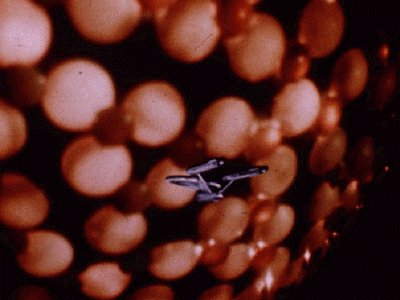
The Enterprise gets logged as a casualty in an interplanetary war that's fought entirely through simulations on a pair supercomputers networked between the two hostile planets. Rather than destroying their cities and eradicating their cultures with real bombs, they just estimate the damages of a theoretical attack, assign people as casualties, and then ask them to willingly walk into a disintegration chamber so their real deaths can be officially recorded. But since they've made war relatively painless, they've had no reason to stop it, so it's gone on in this sociopathic manner for 500 years. Kirk, who, at this point, almost looks like he has a pathological hatred of computers, destroys the computers to protect the Enterprise crew and forces the two factions to actually sit down at the peace table rather than building real weapons. On the one hand, I'm sure there's a really interesting statement about the Vietnam war there, which can very easily be applied to the video game quality of the '91 Gulf War as well. But I also remember this episode because there's a point where Kirk orders Scotty to implement General Order 24 - a Starfleet code for bombarding the surface of a planet with enough phaser blasts to erase all live and make it uninhabitable for years to come. Roddenberry's original vision of the power of a starship was much grander, and scarier, than it was in later years.


"The Doomsday Machine"
One of the worst special effects makes for one of the most intense episodes. Responding to a distress call, the Enterprise finds the burnt out husk of one of their sister ships, the Constellation, amid the debris field of a planet that's been completly obliterated. The only man left alive is the ships commander, Matt Decker, who's gone off the deep end after he encountered a giant robot ship from outside the galaxy that's preprogrammed to blow up planets and consume the remains as fuel before proceeding to the next planet. Decker had ordered his crew to evacuate to the nearest planet, only to watch the planet-killer devour it. They speculate that it's a leftover from a war long since over, and no one was around to shut it off before it started roaming the cosmos, looking for sustinence. The combined fire power of two starships aren't enough, but Decker, overwhelmed by the guilt of losing his crew, goes on a suicide mission to ram a shuttle craft right into the mouth of the beast. Although Decker dies, it gives Kirk the idea to boobytrap the Constellation to blow up once it's inside the jaws of the planet killer.


"The Enemy Within"
A transporter malfunction splits Kirk into two versions of himself: one rational, caring, yet indecisive; the other, violent, craven, and unafraid to take what he wants. My favorite Star Trek scene of all time: the evil Kirk is in his quarters trying to hide the scratches on his face after he tried to rape Yeoman Rand, when the good Kirk gets on the PA and announces that there's an imposter on board. The evil Kirk flips out and ransacks his own room in a hissy fit, screaming at the top of his lungs "I'm Captain Kirk! I'M Captain Kirk! I - AM - CAPTAIN - KIRRRRRRKKKK!!!!!!".

If you love Shatner's over-the-top acting, this episode is priceless. In my second favorite scene from this episode, the good Kirk faces the evil Kirk in engineering. Good Kirk tries to make nice by telling his twin that he needs him, to which, the evil Kirk just sneers "I - DON'T - NEED - YOU!!!


Of course, there are tons of other gems, like "Charlie X", where an adolescent boy with no social skills but the power to alter reality at his whim, simply marches onto the bridge and brags "I can make you ALL go away! Any time I want to." Or the surreal "Spectre of the Gun", where Kirk & Co. are trapped in a dream world where they must play the losing side in a deadly serious reenactment of the Shootout at the O.K. Corral and Spock must use his telepathy to give the others the mental discipline to deny the reality of the Earp Bros. bullets.

Spock's dialogue ("They are falsehoods. Lies. Shadows, without form or substance. They will not pass through your body, for they - do not - exist.") are strikingly remeniscent of "There Is No Spoon" from "The Matrix".

Of course, even if this is the demise of Scott Bakula's Enterprise, I'm sure it won't be too long before Paramount finds a way to resurrect the property. In the meantime, I suppose I'll have to do my part to bring a show about big ideas back to television.

OK. I'm through indulging now.